What Does a Neo-Nazi Group Actually Buy When It Marches Past Your House?
Christopher Pohlhaus leads a neo-Nazi group called the Blood Tribe. Its members turn up at drag story hours in uniform and visibly armed, shout for a while, and go home. No shots are fired, no charges are filed, and the following year the event is quietly off the calendar. That last part is what the morning was for, and one sentence in the scene shows it was planned.
A Saturday morning in a small town. Families queue outside a public library for a drag story hour. Across the street a row of masked men appears in black uniforms, with neo-Nazi insignia, red and black flags, and wooden shields. They say nothing. They don't cross the street. They don't touch anyone. Police watch and make no arrests, because no law has been broken. Within thirty minutes the organisers end the event early and parents walk children back to the cars.
Pohlhaus did a short stint in the United States Marine Corps and came out a Nazi. He now leads the Blood Tribe, whose members spend their days at LGBT events, Drag Queen Story Hour in particular, heckling the crowd. Photographs of him at those events show him armed, with what looks like a magnum strapped to his belt. He came to wider notice partly through Task Force Butler, a group of veterans who use open source investigation and legal methods against violent extremism.
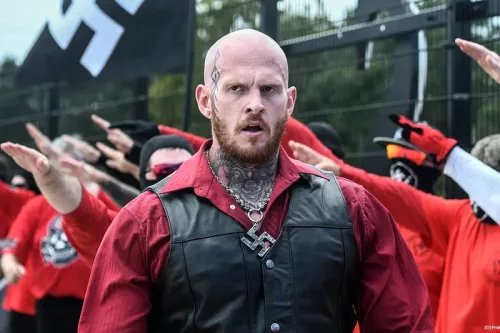
Task Force Butler also surfaced the sentence Pohlhaus uses to describe what his group is doing.
So what we want to do is maximise aggression, the noise, the volume, while also maximising safety for them. We go to the enemy, scream at them, give them PTSD, and leave.
The safety being maximised is his own. If one of his men shoots somebody, that man spends the rest of his life in prison and the marches stop. Pohlhaus spent time in the Marines, so he knows what PTSD is and what it does to people who have it. The queue he sends his men to scream at contains children.
There's footage of children arriving at that same story hour through the crowd. An adult voice keeps repeating, 'Don't engage. Don't engage.' A girl of about fourteen or fifteen walks past police officers, chanting, swearing, a man in fancy dress and somebody who might be carrying a gun, on her way to hear a story. She looks terrified.
The analyst who assembled this case said he'd happily take his own children to a drag story hour and had never been to one. He also said that if he pulled up outside and found that mob on the pavement, he'd start the engine again and drive off. Then he heard what he'd just said. Driving off is the whole outcome.
In America the same street produces armed counter-protesters. Members of the John Brown Gun Club, an LGBTQ group organised along the lines of the right-wing militias, turn up at these events carrying similar military-grade weapons, so two heavily armed groups end up facing each other at point blank range. Jeff Charlotte, who wrote The Undertow, compared it to striking matches over dry grass. Most go out. One of them doesn't, and nobody knows which.
The tactic travels without the firearms. A journalist interviewing Kimberley Urgewood of Public Child Protection Wales, a group that mounts protests at drag story hours in the UK, put it to her that children arriving at these events are upset by adults shouting about sexualisation and paedophiles, and that this is damaging for them. Her reply was that if the parents know this is going to happen, they shouldn't be taking their children there.
Structure is part of why this is cheap. In 2020 FBI agents took apart a hierarchical white supremacist cell the familiar way, by flipping a lieutenant and mapping the chain of command. It worked because there was a chain of command. Then the Boogaloo Boys turned up at protests in Hawaiian shirts carrying rifles, with no leader and no membership list. There's no membership list for an aesthetic and nothing to subpoena in a dress code. Shouting on a public street isn't a crime either.
The one question that separated a nuisance from an operation
Take the effect you can see on the ground and ask whether the people producing it have described that effect themselves as something they were going for. It's a comparison between two things that are usually read separately, the outcome and the actor's own account of the plan.
On the ground, the outcome is an event ending early and then vanishing from next year's calendar. In Pohlhaus's own words, the aggression is to be maximised, the safety belongs to his side, and what his men leave behind is PTSD. He puts the fear in the position of the product and his own liberty in the position of the constraint. Urgewood's reply does similar work from the other end, treating the distress of children as a reason for families to stay at home.
What the Blood Tribe buys with a morning outside a library is an absence. For every person willing to battle through the scrum, roughly ten more decide the risk isn't worth it, whatever is on the other side of the door, a drag story hour or a Bible reading. The event ends early, then the next one is smaller, then it isn't in the diary at all. Nobody had to be shot for any of that, and Pohlhaus's men drove home free to do it again.
Moghaddam's staircase describes the climb from mild irritation to an act of terrorism as a set of steps most people never finish. These marches sit on one of the lower steps, the one where you turn up, scream, and go home. It's the step that costs the men on it almost nothing.
Reading a group's stated aim against the effect it produces is a move rather than a knack, and it works on quotes nobody has published yet. It is one move out of several that made this case legible.
Where chilling effects get taken apart
The Blood Tribe is one case in a course about how disinformation and violent extremism meet on the same street. It covers where the line between extremism and violent extremism actually falls, why groups traded org charts for aesthetics, and how chilling effects and escalation pack tight enough to catch light.